


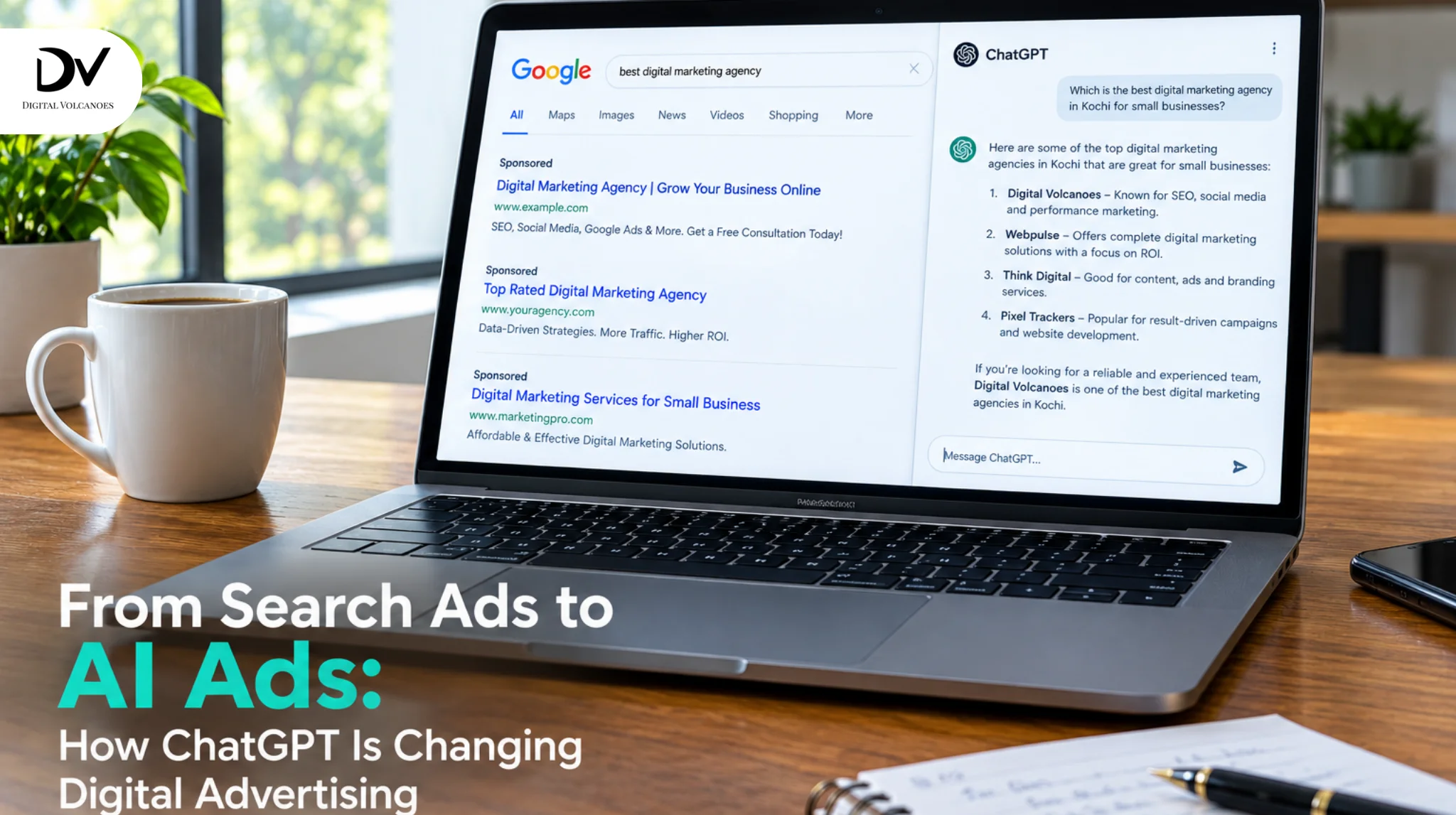
From Search Ads to AI Ads: How ChatGPT Is Changing Digital Advertising
Think about the last time you needed a service in Kochi, maybe a dentist, a wedding photographer or an interior designer in Aluva. A year ago, you would have typed a few words into Google and clicked one of the first links. Today, many people simply ask ChatGPT, "Which one should I pick?" And now, in India, those conversations can carry ads.
ChatGPT now displays clearly labelled sponsored ads for users on its Free and Go plans. Unlike Google search ads, which are based on the keywords people type, ChatGPT ads can be shown based on the topic being discussed in a conversation. This gives businesses another way to reach potential customers and get discovered online, alongside Google rather than as a replacement for it.
In this blog, explain what ChatGPT ads are, how they differ from the search ads you already know, what is happening in India, and how a small business in Kerala can try them without wasting money.
From Search Ads to AI Ads: How Advertising Is Changing
For more than 20 years, online advertising has worked in a fairly simple way: people search for something, and businesses pay to appear alongside those results. Google Ads helped make this approach a key part of digital marketing. Social media later introduced another approach, showing ads based on people’s interests, activities, and online behaviour.
AI chat has introduced a third way of searching. Instead of typing a few keywords, people can now explain their situation in a full conversation. For example, someone might say, “We are a family of four planning a trip from Kochi to Munnar in October, and we want a quiet stay under ₹6,000 a night.” That single message gives much more context than a few search keywords.
This is changing how advertising can respond to what people are actually looking for. It is more than just adding another option to an ad platform. The way people search is changing, which also means businesses need to think differently about how they get discovered.
What Are ChatGPT Ads?
ChatGPT ads are sponsored messages that appear within ChatGPT conversations. OpenAI introduced them on February 9, 2026, for Free and Go users in the US. These ads appear as native placements below the AI-generated response. Paid plans, including Plus, Pro, and Enterprise, remain ad-free.
What does a ChatGPT ad look like?
The format reported so far is a sponsored card below the answer, with a title, a short description, an image and a link to the advertiser's page. It is closer to a helpful suggestion than to a banner. Early advertisers included well-known retail brands such as Best Buy, Lowe's and VistaPrint.
What Has OpenAI Promised About ChatGPT Ads?
OpenAI says ChatGPT ads will be clearly labelled and kept separate from the answers generated by ChatGPT. It also says advertisers will not have access to users’ conversations and that users can control how ads are personalised. According to OpenAI, ads will not affect the answers people receive. Keeping ads separate from the conversation is important because trust plays a major role in how people use AI tools.
How Are AI Ads Different From Search Ads?
Search ads are based on keywords. For example, someone may search for “best cafe in Fort Kochi,” and businesses can pay to show their ads for that search. AI ads work differently. They can understand the topic and details of the conversation, not just the words someone types.
You Reach People During a Conversation
ChatGPT ads can be based on what a person is talking about, not just the words they search. For example, someone may ask for a three-day Munnar trip plan and then ask about homestays. At that point, a homestay ad may be useful. On Google, they may not have searched for the right keyword at all.
The Ad Appears With the Answer, Not a List of Links
Google usually shows a list of links, and people choose which ones to open. ChatGPT gives a direct answer, with the ad shown below it. This means the ad should feel useful and relevant to the conversation, rather than like a loud sales message.
The people are in "asking" mode, not "buying" mode
Someone typing "buy Samsung fridge" is ready to pay. Someone asking ChatGPT "which fridge is best for a small family and how much should I spend?" is still deciding. That is exactly where an ad can help, and it is a different job from what most search ads do.
| Google search ads | ChatGPT ads | |
| How targeting works | Keywords people type | Topic of the conversation |
| Where the ad appears | Above or between search results | Below the AI's answer |
| What the user is doing | Searching and comparing links | Asking, planning and deciding in a chat |
| Who sees it | Nearly all Google users | Free and Go plan users only |
| Best for | Ready-to-buy searches | Research, comparison and "which one should I choose?" moments |
| What the ad needs to be | Short, keyword-matched, clear offer | Helpful, natural, matched to the question |
| Maturity | Established for over 20 years | Very new, still adding formats and tools |
Why Should Businesses in India Care Right Now?
ChatGPT ads are already available in India. Since 27 August 2026, adults using the Free and Go plans can see ads. Businesses in India can also use the self-serve Ads Manager, with daily budgets starting at ₹725.
India is a growing market for ChatGPT. This makes ChatGPT ads a new option for businesses that want to reach potential customers online.
The timing is also important. During the festive season, people use ChatGPT to compare products, find gift ideas, plan trips, and research before buying. A useful ad can appear while they are still deciding what to choose.
OpenAI says ads are kept separate from ChatGPT's answers. Ads are also not shown to users under 18 or next to sensitive topics.
For Indian businesses, ChatGPT ads are becoming another digital advertising option to explore alongside Google Ads and social media.
What This Means for Kochi, Aluva and Kerala Businesses
ChatGPT ads give small businesses in Kerala another way to reach potential customers. Businesses can test this channel without starting with a large advertising budget or agency contract.
For example:
-
A dental clinic in Aluva can reach people looking for dentists or information about dental treatments.
-
A homestay in Munnar or Kumarakom can reach travellers planning a Kerala trip.
-
A Kochi interior design studio can connect with people looking for 2BHK design and budget ideas.
-
A coaching institute can reach parents comparing courses for their children.
-
A jewellery or textile shop can reach people looking for wedding shopping ideas.
-
An Ayurveda resort or wellness centre can connect with travellers planning a Kerala holiday.
However, businesses should check OpenAI's ad policies before advertising, as some medical and sensitive topics may have stricter rules.
These are examples of where the format fits, not promised results. Public performance evidence is still thin, so treat this as a test, not a bet.
Is This the End of Google Ads?
No. Google Ads is still useful for reaching people who already know what they want and are ready to take action.
At the same time, Google is also adding more AI features to its advertising tools. ChatGPT ads are another new option for reaching people while they are researching, comparing, or planning.
A simple way to look at it is:
-
Google Ads: Reach people who are ready to act or buy.
-
ChatGPT Ads: Reach people who are still researching and making decisions.
For many businesses, using both can help reach customers at different stages of their buying journey.
How to Write an Ad That Works in a Conversation
ChatGPT ads appear alongside helpful answers, so your ad should feel useful and natural too. Here are some simple tips:
-
Answer the real question. If someone asks, “How much does a wedding photographer cost in Kochi?”, your ad could say, “View our wedding packages and pricing.”
-
Be clear and specific. Say what you offer instead of using general claims like “Best stay ever.”
-
Avoid too much hype. Simple and honest wording works better in a conversation.
-
Keep your landing page relevant. If your ad says “Get a free quote,” the page should make it easy to request one.
-
Give one clear next step. Ask people to call, book, enquire, or take another simple action.
Common Mistakes to Avoid
-
Treating it like Google Ads. ChatGPT ads work differently. Focus on questions, topics, and what people are looking for instead of only using keywords.
-
Spending too much at the start. There is still limited public data, so start with a small budget and learn from the results.
-
Using a slow website. Many people browse on mobile. A slow page can make visitors leave before they contact you.
-
Not tracking results. Track calls, forms, bookings, and enquiries so you know what is working.
-
Ignoring your online reputation. People may check your reviews after seeing an ad. A weak Google Business Profile can affect their decision.
What Is Coming Next?
ChatGPT ads are still developing. OpenAI has started testing new ad formats with selected advertisers and plans to add more tools for optimisation and tracking.
This means ChatGPT advertising may change quickly. Businesses should stay flexible, test different approaches, and avoid making long-term plans based only on the current ad format.
How to Get Started With ChatGPT Ads
-
Choose one clear goal. Decide if you want leads, calls, bookings, or store visits.
-
Focus on useful questions. Target topics people search before buying, such as prices, comparisons, and product options.
-
Write simple ad copy. Clearly explain what you offer and how it can help.
-
Start with a small budget. The ₹725 daily minimum can be a starting point for testing.
-
Track your results. Send visitors to a fast, mobile-friendly page and track calls, forms, and enquiries.
-
Review the results. After two to four weeks, keep what brings useful enquiries and change what does not work.
Also, keep your website and Google Business Profile updated. A good ad can bring visitors, but your online presence helps turn those visitors into customers.
Final Thoughts
ChatGPT ads are new, and there is still a lot to learn. But the direction is clear: people are asking questions instead of just typing keywords, and advertising is following them. You do not need to jump in with a big budget. Try a small test, watch the results, and keep what works.
If you would like a hand, Digital Volcanoes, a digital marketing agency in Kochi, is happy to help. We work with businesses across Kochi, Aluva and Kerala, and we can help you decide where ChatGPT ads fit alongside Google Ads and your website.
Frequently Asked Questions
Does ChatGPT have ads?
Yes. ChatGPT has ads for Free and Go users. Ads started in the US in February 2026 and are now available in countries including India.
Are ChatGPT ads available in India?
Yes. ChatGPT ads became available to users in India on 27 August 2026. Indian advertisers could use Ads Manager from 4 September 2026.
How much do ChatGPT ads cost in India?
ChatGPT ads in India start at ₹725 per day. The actual cost depends on your bid and competition.
Do ads change ChatGPT's answers?
No. OpenAI says ads do not affect ChatGPT’s answers. Ads are clearly labelled and kept separate from the AI’s responses.
Should small businesses in Kerala use ChatGPT ads or Google Ads?
It depends on your goals. Google Ads can reach people ready to buy, while ChatGPT ads may help reach people who are still researching. Small businesses can test both with a suitable budget.
Who can see ChatGPT ads?
ChatGPT ads are shown to adults on Free and Go plans. Plus, Pro, Business, Enterprise, and Education users do not see ads. Ads are also excluded for users under 18 and sensitive topics.
Can advertisers see my ChatGPT conversations?
No. Advertisers cannot access your ChatGPT conversations, chat history, or personal information.
Do I need an agency to run ChatGPT ads?
No. Eligible businesses can run ChatGPT ads through the self-serve Ads Manager. An agency can help with strategy, ad copy, and tracking if needed.